Contains spoilers for the films Barbie (2023) and Little Women (2019)
Remember Proust Barbie? Don’t fret if you don’t! That’s because she was one of the few Barbies appearing in the movie who was never made in real life. Blink and you’d miss her – I confess it was keener eyes than mine who spotted her – but she’s played by the rather fabulous Lucy Boynton.
It’s a delightful visual gag on top of a charming joke. Earlier in the movie Mattel chief executive (Will Ferrell) tries to capture Stereotypical Barbie (Margot Robbie) by persuading her to get into the box in which the Barbie dolls are sold. She reminisces that that she hasn’t been in a box for a very long time, but as soon as she steps in and experiences the smell, she exclaims “I’m having a real Proustian flashback.” So far, so unexpected. But the CEO then takes it further with his own flash of recollection. “Remember Proust Barbie?” he asks the rest of the Mattel management team. “That did not sell very well.”
Director Greta Gerwig has acknowledged it’s something of a niche joke, though perhaps one which may have made Marcel Proust laugh, but the whole film is steeped in themes of memory, nostalgia and archives.
Memory – and indeed Proust – is a recurring theme for Gerwig. Towards the end of the film is a montage of flickering home-movie style images; memories to help Barbie understand what it is to be a human who gets old instead of an ageless doll in a world of everyday perfect days. While Proust’s Remembrance of Things Past explores time, memory and loss, critic Hannah Strong says, “Barbie is… a film about what a joy it is to create those memories to begin with. To spend time with loved ones, to play with toys and lose ourselves to imagination; to find friends, to have parties, to exist on our own terms. To remember all the love, and the loss, and the strange, agonisingly short experience of being alive.”
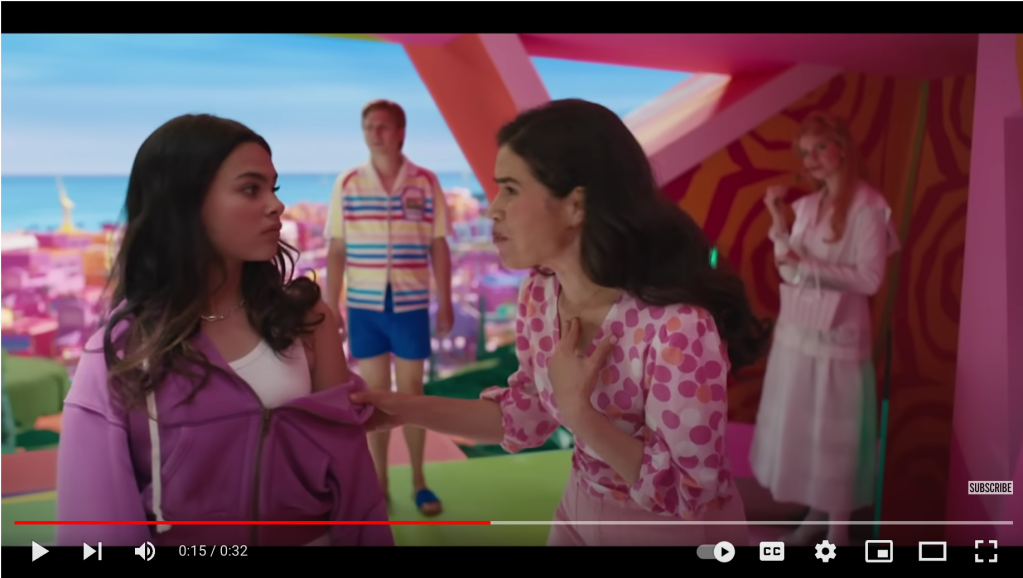
In Barbie, it’s a mother’s nostalgia for the happy times she spent playing with the doll with her daughter that is the cause of Barbie’s existential crisis. The melancholic longing of Gloria (America Ferrara) for that lost time of a harmonious relationship with young Sasha (Ariana Greenblatt) impinges on Barbie’s perfect life, and draws her to the Real World.
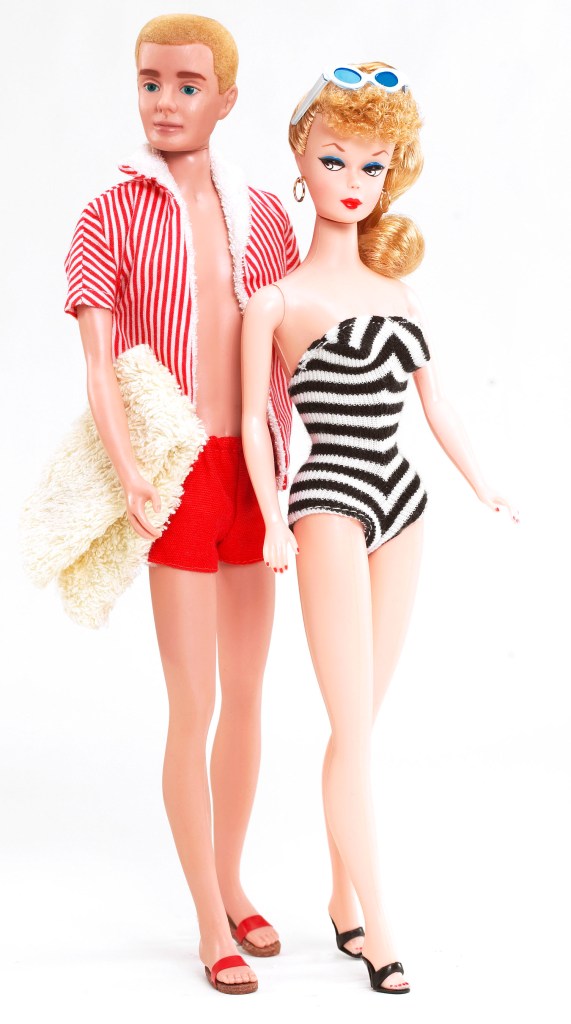
Barbie has been around since 1959 so plenty of time for several generations to develop nostalgic feelings for her. Nostalgia was originally a medical condition, a painful wistful longing for home experienced by displaced persons. Now however, it has more elements. As cultural theorist and artist Svetlana Boym wrote, “… it is actually a yearning for a different time – the time of our childhood, the slower rhythms of our dreams. In a broader sense, nostalgia is a rebellion against the modern idea of time, the time of history and progress”.
We’re all displaced from our childhood and can never return but for children of the post-war economic boom, there seems to be a solution to assuage the pain of yearning, termed “consumed nostalgia” by cultural historian Gary Cross who suggests that “…today, we can get back “home” by collecting a toy or doll from our childhood (or a rock song or used car from our youth), which will not go away like our actual childhood worlds… These are the consumer goods of our “wondrous innocence,” memories of childhood and youth, of purchases, gifts, and play.”
It’s a powerful emotion, and no doubt some of this nostalgia has helped to draw in the massive audiences. The film itself is populated with faithful representations of real products from the Mattel back catalogue (with the exception, of course, of Proust Barbie). It constitutes an affectionate tribute to ‘the archive’ but it also acknowledges the role of consumerism and capitalism in creating this emotional connection.
While Gloria is very excited to see Barbie in real life, angry tween Sasha calls her a fascist and yells: “…You represent everything wrong with our culture: sexualized capitalism, unrealistic physical ideals. Look at yourself. You set the feminist movement back 50 years. You destroy girls’ innate sense of worth, and you are killing the planet with your glorification of rampant consumerism.”* (Incidentally, the cue for another good joke, as a bewildered Barbie sobs that she’s not a fascist because, “I don’t control the railways or the flow of commerce!”).
On their journey to Barbie Land Gloria fondly remembers the Barbie products she had as a child and laments the items she lost and couldn’t replace because it would mean buying another doll. When Ken (Ryan Gosling) ejects Barbie from the Dream House he throws away her outfits too, naming each in turn with their perky slogans created by marketeers. The discarded clothes are tempting for Gloria, and Sasha too: “They’re archival!” they murmur excitedly to each other but ultimately decide to leave the clothes where they lie.
While the power of consumed nostalgia is recognised as a powerful force, the film also catalogues corporate failures – where Mattel misjudged the market – and in fact it’s those oddball Barbies and Kens (and Allan!) who are founding members of the Barbie Land resistance when Ken – radicalised by his time in the Real World – tries to establish a patriarchy. Thus capitalism’s ‘cock-ups’ are the vanguard of the revolution.
And during Ken’s de-radicalisation Barbie persuades him that he is not defined by his possessions – his mink coat, his minifridge, his car, his horse paintings – but must instead learn to know himself. His future is not accumulating stuff but self-actualisation.
Gerwig has revisited the shibboleths of childhood before with her meta reworking of Little Women, where she both paid homage to the book and added a new layer that dissected the compromises the artist makes with capitalism, as writer Jo negotiates a market-friendly ending for the heroine in her own book. To get her book into the marketplace where it can reach the widest audience she decides to accept compromises to her vision.
Nostalgia is often considered to be a reactionary force – see the use of Second World War metaphors for almost any challenge in British political life from austerity to Brexit to COVID-19 – and is employed by both right and left sides of the political divide to, er, rally their troops.
But both Barbie and Little Women actively do the work of addressing the need to meet these strong emotions head-on. As Peter Mitchell, author of ‘Imperial nostalgia. How the British conquered themselves’ says, “We need to think more introspectively about the affective content of nostalgia: everyone mourns, everyone has a childhood, everyone is susceptible to the remembrance of things past, and that’s not inherently a bad thing. We all live though our past.”
Gloria and Sasha re-connect when they help to end the nascent patriarchy in Barbie Land. The much-discussed monologue where Gloria presents the contradictions and cognitive dissonance of living as a woman in the Real World patriarchy, has been criticised for being focused on ‘first world problems’ (though do note the “White Saviour Barbie” joke). But, as well as snapping the Barbies out of their fugue state, it allows Sasha to more fully understand the pressures of her mother’s existence. Meanwhile Barbie meets her own ‘mother’, Ruth Handler (Rhea Perlman), who explains why she created Barbie and helps her undertake the next part of her journey, moving from doll to human form.
Equipped with new understanding of the past, and the present, both of the daughters are ready to go further, a situation captured in Ruth’s statement that “mothers stand still so that daughters can look back to see how far they’ve come.” Barbie can be anything she wants. And what she chooses is not the static past but an uncertain new future; she chooses NOT to be Barbie any more. It’s not a simple fairytale of transformation. They’re still living in a capitalist context – a point made when Gloria’s pitch to create an ‘Ordinary Barbie’ is instantly rejected by the Mattel CEO until he’s advised that it would be a commercial success and abruptly changes his mind – but Barbie succesfully transitions to the Real World complete with a new name, a place where, as she puts it, she can “be part of the people that make meaning, not the thing that is made.”
So although nostalgia is “a favoured tool of reaction”, Peter Mitchell also says, “I don’t think it’s inherently reactionary. I don’t think it has to limit us or our political imagination.” Barbie tells us that we do need to remember the hopefulness and joy of childhood. Not so we fall into nostalgic yearning for those days as an escape from the current reality. Instead of feeling defeated by our real world, we can use that remembered hope and joy – and history too – to create a future that is better than the past. Nostalgia doesn’t have the power to hold us imprisoned in a rose-tinted world but instead can cast a light on the path ahead.
Footnote
*Sasha’s view is nearer to my personal memories; I didn’t have a Barbie because my parents disapproved of a toy they considered to be a symbol of sexism and the empty commercialism of American culture.
Sources
- Svetlana Boym, ‘Nostalgia and its discontents.’ The Hedgehog Review, volume 9, number 2, summer 2007, https://hedgehogreview.com/issues/the-uses-of-the-past/articles/nostalgia-and-its-discontents
- Charles Bramesco, ‘Barbie: the patriarchy, the existentialism, the capitalism’, The Guardian, 24 July 2023 https://www.theguardian.com/film/2023/jul/24/barbie-movie-spoilers-themes
- Kyle Buchanan, ‘Greta Gerwig on the Blockbuster ‘Barbie’ Opening’, New York Times, 25 July 2023 https://www.nytimes.com/2023/07/25/movies/greta-gerwig-barbie-movie.html
- Gary Cross, ‘Nostalgic collections’, Consumption Markets & Culture, Volume 20, Issue 2, 2017, https://doi.org/10.1080/10253866.2016.1167469
- Nora Dominick, ’31 “Barbie” Details That Are Small, Amazing, And Prove It’s One Of The Best Movies. Period.’ Buzzfeed, 25 July 2023, https://www.buzzfeed.com/noradominick/barbie-details-easter-eggs (Points 18 and 19)
- Aviva Dove-Viebahn, ‘Barbie’ is, at its core, a movie about the messy contradictions of motherhood, The Conversation, 1 Aug 2023, https://theconversation.com/barbie-is-at-its-core-a-movie-about-the-messy-contradictions-of-motherhood-210433
- Dan Hancox, ‘Who remembers proper binmen?’ The nostalgia memes that help explain Britain today’, The Guardian, 15 November 2022 https://www.theguardian.com/news/2022/nov/15/who-remembers-proper-binmen-facebook-nostalgia-memes-help-explain-britain-today
- Barbie, Internet Movie DataBase, https://www.imdb.com/title/tt1517268/
- Helen Macdonald and Sin Blaché, ‘Our book is Barbie meets Oppenheimer’: why we wrote about nostalgia in an era of crisis, The Guardian, 4 August 2023, https://www.theguardian.com/books/2023/aug/04/our-book-is-barbie-meets-oppenheimer-why-we-wrote-about-nostalgia-in-an-era-of-crisis
- Peter Mitchell, in conversation with Hussein Kesvani, ‘A little nostalgia as a treat’, Ten Thousand Posts, 4 July 2023, https://tenthousandposts.podbean.com/e/a-little-nostalgia-as-a-treat-ft-peter-mitchell/ (podcast)
- Rotten Tomatoes, ‘Barbie Movie Clip – Weird Barbie (2023)’, YouTube, August 2023, https://youtu.be/66cMkxolaHM?si=TvlbwUoMvy_fz7hF
- Hannah Strong, ‘Barbie review – a gorgeously weird blockbuster event’, Little White Lies, 18 July 2023, https://lwlies.com/reviews/barbie/
- Michael Wood, ‘Was Marcel Proust A Comedian? On the Unexpected Humor of In Search of Lost Time’, Literary Hub, 25 August 2023, https://lithub.com/was-marcel-proust-a-comedian-on-the-unexpected-humor-of-in-search-of-lost-time/
 Lucy Janes