I ended 2023 with a few half-read books piling up, so this year I started with one of those, but despite that initial momentum I soon slowed down again. So only 36 books this year, though I did a bit more reading for work, so perhaps that ate into some reading for pleasure time. Or maybe I was just lazy!
But regardless of the how few books I picked up, I do need give big thanks to Glasgow City Libraries who kept me freely supplied with such a wide variety of reading.
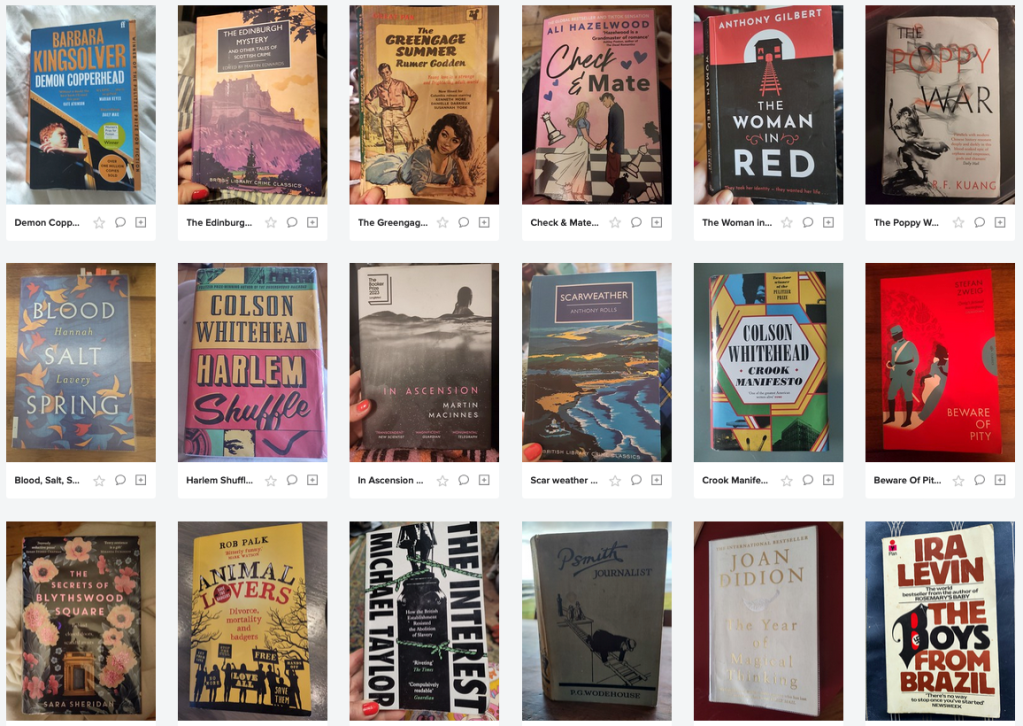
Demon Copperhead by Barbara Kingsolver
Obviously this book has had all the praise. And it really deserves it. It’s a beautiful and compassionate story of families and love, of poverty and loss, of giving up and of going on. The settings and characters are all so convincing, and Demon Copperhead himself is hurt and mistreated but brave and true – and loved too – while being caught in history and circumstances that drive his life in painful directions. It’s about how kind, courageous people can sustain each other even when living in despairing communities on the brink of collapse, helping some at least to emerge on the other side. Deeply moving.
The Edinburgh Mystery and Other Tales of Scottish Crime edited by Martin Edwards
I chose this for its Scottish connection, which included stories by Robert Louis Stevenson and Arthur Conan Doyle and many others. Writing 12 months after reading I can’t remember a single one of them but that’s nothing unusual for me, especially with crime fiction where I can happily re-read the same book over and over again, and still be surprised by the solution! I do recall that the RLS was more of a reflection on crime rather than a detective story. So nothing outstanding but I’m pretty sure I enjoyed the tales.
The Greengage Summer by Rumer Godden
I really enjoyed this story of a family of four English siblings fending for themselves in a slightly racketty French hotel after their mother is taken into hospital when they are on summer holiday. They knock about the hotel, run by a glamorous French woman aware that her allure is fading. Also in situ is her lover, a mysterious but charming Englishman to whom the children are drawn, romantically so in the case of the eldest daughter, 16-year-old Joss. There are various strange incidents, then an actual crisis when something pretty bad happens, yet the whole thing also manages to feel quite frothy and light as well as a bit disturbing.
Checkmate by Ali Hazelwood
I’d enjoyed a romance by Ali Hazelwood in 2022 so picked this up on a whim in the library. It’s not a million miles from the other one in that the storyline is a poor but proud young woman meeting a privileged young man, only this time set in the world of chess. Circumstances force Mallory Greenleaf to return to playing competitive chess, where it is rapidly apparent her skill equals and maybe surpasses that of prince-in-waiting Nolan Sawyer and also his nearest rival, the boorish and sexist king of the competitive game. You can guess where it all going but it’s a perky and pleasing ride getting there.
The Woman in Red by Anthony Gilbert (Lucy Beatrice Malleson)
I found this wartime thiller rather unsettling. A young woman with no relatives and desperate circumstances is offered a job which ends up with her being drugged and kidnapped. Most of the book focuses on her efforts to escape before anything worse befalls her, and the attempts by the one person who does miss her to get a slightly dodgy private detective to find her. Worth reading if you like old-school crime novels.
The Poppy War by R.F. Kuang
Having very much enjoyed her satire of the publishing industry (see 2023) and being reasonably keen on fantasy I thought I’d give Rebecca Kuang’s first novel a go. It’s the first in an epic series set in an fantasy world but drawing on Chinese 20th century history. Rin, a poor peasant girl, through innate talent and hard work, makes it into an elite magical / military school, where she discovers she has the rarest and most unstable type of magical power. This gives her immense force when the students have to go to war to defend their nation but, of course, ‘with great power comes great responsibility’….. I enjoyed the sweep and ambition, but it’s frequently brutal stuff – as indeed was Chinese 20th century history – and while you can admire Rin’s unrelenting determination she’s often – for very understandable reasons – a hard person to like. So I didn’t rush to the second in the series but may give it a go at some point.
Blood Salt Spring by Hannah Lavery
A Book Group choice, unusual for us, being poetry, though we did meet on Burn’s Night so fully appropriate! It was also unusual for me; I don’t read a lot of poetry and I was mildly bamboozled as to how to approach a whole book of it. In the end I did what I do with all my reading; started at the beginning and went straight on through. There were some I liked – one about a Christmas tree glimpsed from an urban train in January really appealed to me – but I was less taken by the pieces about COVID lockdowns and racism as, to me, the language seemed too solid, and not allusive enough to enable me to enter the experience.
Harlem Shuffle by Colson Whitehead
What a fabulous book! In early 1960s Harlem, Ray Carney attempts to navigate a tricky path from poverty and a criminal family background to middle-class respectability. He runs a furniture store, selling to people on similar trajectories, but he also occasionally gets sucked back into the shady stuff. Meanwhile his wife, from a fancier local family, is involved in the civil rights struggles, though there’s also some dodgy dealings going on there. The writing is so skillful, the characters are all brilliantly realised, including the minor ones, as is the web of connections, obligations and interactions that link them all. It’s gripping, funny, and moving, along with perfectly delightful little details of 1960s living room suites.
In Ascension by Martin MacInnes
Ooof, this is a proper epic! Firmly in the orbit of Solaris, Ad Astra and 2001: A Space Odyssey rather than Star Wars, it’s cli-sci-fi with added transcendendance. At the core of the story is Dr Leigh Hasenboch, an obsessive scientist from a dysfunctional family, who studies photosynthetic eukaryotic organisms – algae to most of us. She is present at the investigation of a newly-discovered, mysterious and unbelievably deep oceanic trench, and is strangely affected by diving in its waters. Then her algae expertise becomes invaluable to a secretive space mission triggered by other unexplained global and interstellar phenomena. I think it’s about climate and the urgent need for us to save ourselves but I did find it all quite mysterious as well as beautifully written. It’s extremely well done and I’m glad I read it but it’s perhaps not a book I will revisit.
On a side note, I don’t often react to book covers but I had the hardback which shows a person in the sea in back and white which I felt made the ocean seem more menacing and less wondrous than MacInnes makes it; I was interested to see that on the paperback version the water is imbued with intense other-wordly blue.
Scarweather by Anthony Rolls (C.S. Vulliamy)
A 1930s msytery novel, though to be honest, there’s not much in the way of mystery about the plot. It unfolds pretty much as you anticipate. But it does have spooky atmosphere and some jokes about vicious debates amongst archaeologists so if you like minor Golden Age stuff it might be worth a few hours of your time.
The Crook Manifesto by Colson Whitehead
The sequel to Harlem Shuffle takes Ray Carney into the early 1970s and, though his business and life is on a firmer footing, and his furniture showroom is being used a filming location for a blaxpoitation movie – with which Whitehead has a lot of fun – again he’s sucked into the criminal byways of New York. Only it feels that the city is more dangerous, more pitiless, more knife-edge than before. Throw in some radical politics and police corruption and a quest for Jackson Five tickets and it’s a totally brilliant amalgam of family saga, American political and cultural history and crime thriller.
Beware of Pity by Stefan Zweig
A Book Group choice, this time by me. I like 1930s novels and had been meaning to read Zweig for a while so it seemed a good option. I also like a story with a dim-witted ‘hero’, and this one definitely fits the bill! There’s a brief scene-setting in interwar Europe but the main story is told in flashback by soldier Anton Hoffmiller. In Army training since he was a child, he makes a terrible faux pas while in rare attendance at a fancy party just before the First World War. In attempting to rectify his error he is drawn deeper into emotional complexities and flounders into more mistakes, with tragic results. How he gets into this terrible situation is completely convincing along with a lovely evocation of an old world on the cusp of modernity. I loved it.
The Secrets of Blythswood Square by Sara Sheridan
A very satisfying historical novel set in mid-19th century Glasgow. Two women make a connection as one sets up a photography business – when the science / art was still young – and the other struggles to retain her independence and her home after the death of her father, who turns out to have a unsavoury secret. I really enjoyed the ins and outs of their progress, especially the part when they, and another woman, develop a sideline in selling saucy photos! It’s a hoot but also a reminder that the past has many shadowy corners just waiting to brought to light.
Animal Lovers by Rob Palk
An excellent comic novel about a man whose wife leaves him to camp in the woods and stop a badger cull not long after he’s recovered from a serious illness. As he reels from these emotional blows he plots to win her back by faking a similar affection for the furry creatures. Like all good comic novels it’s not only laugh-out-loud funny but also a wee bit sad and moving.
The Interest by Michael Taylor
Based on the author’s PhD thesis this is the fascinating – and somewhat repellent – story of the people in Britain and its colonies who opposed the abolition of slavery and the slave trade in the 18th and 19th centuries. He looks at who they were, the arguments they made, and the organisations and groupings they created to put their cases and defend their interests. It’s very good: well-written, engaging and easy to read.
Psmith, Journalist by PG Wodehouse
Selected from the shelves of a holiday home, this is a peculiar beast. Psmith is accompanying his friend Mike on a cricket trip to New York and gets inadvertently involved in tackling the scourge of slum landlords by taking on the editorship of family magazine Cosy Moments. Despite the social issues, it has the usual Wodehouse array of comic characters – including a medley of prize-fighters, cocky urchins, and kind-hearted cat-loving crooks – and all ends happily. Perhaps one for the Wodehouse enthusiast though.
The Year of Magical Thinking by Joan Didion
This is the go-to grief memoir of recent times, so I thought that’ll be handy. Well, it assuaged my grief for a short period: mostly by making me very cross! It’s undoubtedly a very tragic situation for the author: her daughter is near death in hospital when her husband of 40 years suddenly dies at home. As she struggles through the subsequent year (which includes additional terrible challenges) she reflects on her grief. It’s awful to say it but it’s all very dull and what particularly grates is that she seem to never reflect that her personal experience might be, in part, shaped by her very privileged circumstances. I’m glad if other people find the book helpful but it wasn’t for me.
The Boys from Brazil by Ira Levin
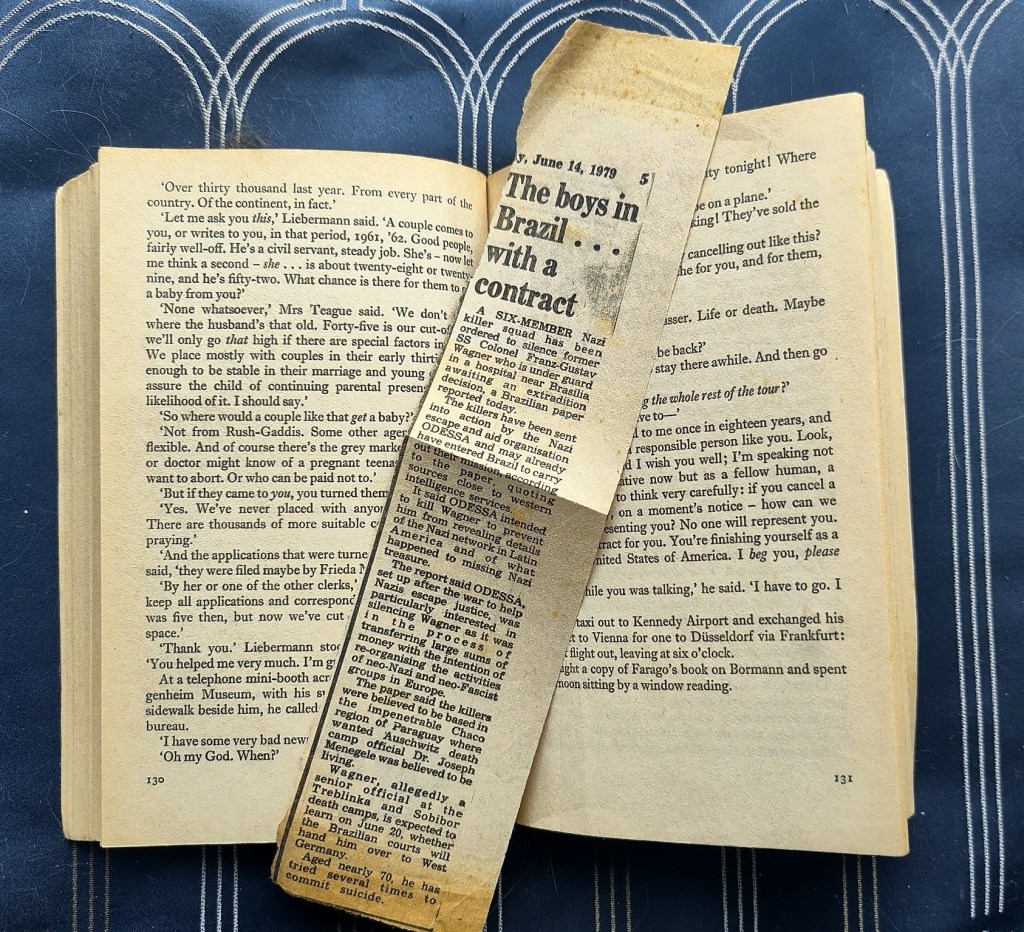
Ira Levin never disappoints and, even if you know the film, the book expertly leads you through the tiny clues that build up into a patchwork that suddenly reveals the full shocking truth, while a parallel storyline offers the grimy motivations and jostling for attention among the Nazi conspirators. It’s a great thiller, well constructed and efficiently written. Also, I picked up my copy second-hand and was totally delighted to discover an old newspaper cutting inside about actual old Nazis on a secret mission in 1970s South America!
Underland by Robert Macfarlane
A really beautiful and interesting read about our relationship with places underneath us, both real and imaginary. It explores how we use and experience physical underground places, and how we think and feel about underworlds as places for the lost, for the dead, for hiding dark secrets and for keeping treasures safe. Robert Macfarlane visits various places, from caves, underground rivers and networks of tree roots, to ancient burial mounds, catacombs and storage facilities for radioactive material. It’s simultaneously fascinating, terrfying and uplifting.
Unofficial Britain: Journeys through unexpected places by Gareth E Rees
There are lots of in-betweeny kinds of places in modern urban Britain – car parks, ring roads, industrial estates and service stations – to which people just don’t pay a lot of attention but Gareth Rees see mystery, stories and ghosts. This ‘guidebook’ to places that may seem to be on the margins but are actually full of meaning, including the occasional slide into slightly more sinister urban folklore, really helps you reconsider the places and structures we overlook as we pass through or skirt by.
A Grief Observed by CS Lewis
Short and, in some ways, very simple but tremendously touching. CS Lewis simply notes how he feels following the death of his wife, and tries to understand what it means to move from being incapacitated with grief to living with grief. Given his Christianity, a significant focus is on faith but, though that held less immediate interest for me, his descriptions of the experience of his grief – physical, emotional, and psychological – really resonated for me.
On this Holy Island by Oliver Smith
I came to this through an interest in walking with purpose. The author describes his journeys to significant places incljuing ancient sites where neolithic poeple lived, gathered and buried their dead, ancient sites of Christian worship, great cathedrals, springs and wells, and places that have modern associations with gathering, mourning and celebration. It’s very generous in spirit, reflective, and inspiring on the importance of such practices to people.
Digging Up Love by Chandra Blumberg
For light relief, another romance. This is the sweet story of the slow-burn passion between small-town baker Alisha and sexy paeleontologist Quentin who is called in to dig up her grandparent’s garden in search of a rare fossil. Along the way there are nerdy dinosaur chats, muddy clothes, misunderstandings, career crises, and tasty cakes. It’s charming and cute but a bit slow and lacks real sparks, so I wasn’t swept away by it.
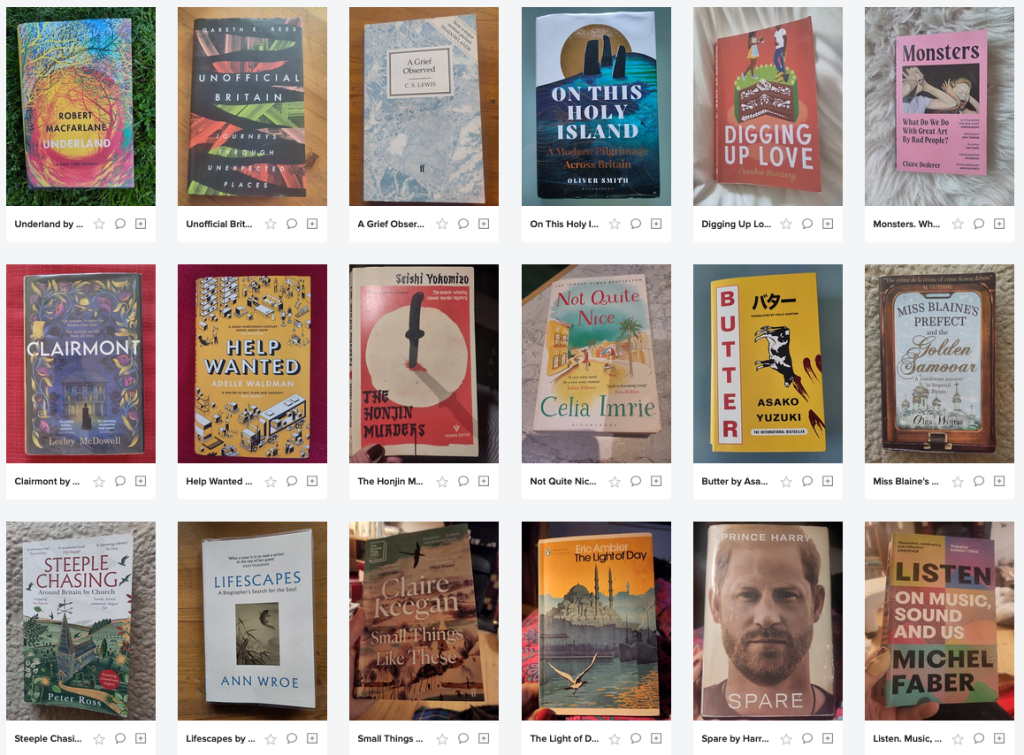
Monsters. What Do We Do With Great Art By Bad People? by Claire Dederer
A Book Group choice. This was a moderately interesting wander around some of the issues people get antsy about when it truns out that someone who created some music or books or films or art they love turns out ot be a horrible person. As you can tell from my introduction I tend to think that you can enjoy it anyway! It was interesting to go around the arguments but in the end she didn’t come to a definitive position other then ‘it’s how you feel’ so I wasn’t sure how far that really got us.
Clairmont by Lesley McDowell
A lovely book imagining us into the mostly unknown life of Claire Clairmont, step-sister of Mary Shelley. It’s a beautifully complex story following Claire backwards and forwards in her eventful life, from a 18-year-old living at Lake Geneva, umarried and pregnant with Lord Byron’s child, to London and Paris, and working as a governess in Russia, though adventure, hardship, tragedy and love, all the time retaining her curiousity, sharp thinking and determination to forge her own path, intellectally and emotionally.
Help Wanted by Adelle Waldman
Comic and touching, this follows the members of the (very) early morning team in a large American supermarket chain who unload the latest deliveries and get the goods on the shelves for the shoppers. When they get the chance to influence the selection of their next manager they hatch a plot to ensure the person they can’t ever respect doesn’t get the promotion. It’s a subtle critique of an economic system that grinds everyone down, even the company ‘winners’, that’s also charming, warm-hearted and humane.
The Honjin Murders by Seishi Yokomizo
A classic locked-room country house murder mystery set in 1930s Japan. Indeed the amateur detective brought in to solve the crime often alludes to his love of Western detective stories and indeed refers to specific cases as he works his way to the solution! The murders are pretty gruesome and the tone can be quite sinister, and, along with the tricky puzzle, it’s all very clever and gripping, as well as atmospheric.
Not Quite Nice by Celia Imrie
A gift, this was a cheery, frothy, sunshiny story following a group of English ex-pats in Nice, as observed by a new arrival who is quickly absorbed into the set. Various nonsense with relationships, family and criminal schemes follows intercut with – in a nice touch – recipes for the dishes that the cookery circle in the book try out as they get to know each other.
Butter by Asako Yuzuki
A Book Group choice. Magazine journalist Rika Machida makes contact with a woman convicted of murdering older lonely older men who she first seduced with fancy cooking. The encounter challenges her relationship with food and her body as she start to eat more luxuriously and put on weight. As her personal relationships change her career gets a boost. Though not without flaws, this is a fascinating novel exploring the pressures on women in Japan.
Miss Blaine’s Prefect and the Golden Samovar by Olga Wojtas
A Book Group choice. Oh my. What to say. about this rather peculiar – not in a good way – book! It’s evidently supposed to be comic with a quirky unreliable narrator in librarian Shona McMonagle who time-travels to 19th century Russia to change history to an incredibly minor degree. She also nurtures a hatred of the novel The Prime of Miss Jean Brodie which, even if intended to indicate that she lacks judgement, seems like rather a bold stance to take on one of the best loved and most admired Scottish novels! Baffling, annoying and tedious….
Steeple Chasing by Peter Ross
Having been delighted by A Tomb with a View (see 2021) because I love cemeteries, I was very excited to learn that this follow-up was on churches, which I also I love! He explores differen aspects to chgurches in conversation with people who have their own special relationships with some particular places; there’s a chapter on church cats, on lost and lonely – friendless – churches; city cathedrals; the vast edifices of the Fens; holy wells; abbeys; modern ruins and more. Beautifully written, it’s informative, insightful, and uplifting.
Lifescapes by Ann Wroe
I found this a bit of tricky read. I expected more of a description on what it was like to be an obituaries writer but this is a looser, more expansive, reflective exploraton of what makes a life. She weaves recollections from her life with reflections on how she found ways into capturing individual’s lives – which was often not in their big achievements but in the small stories – along with poetry. I think this is probably a good book but perhaps it wasn’t quite the right book for me when I read it.
Small Things Like These by Claire Keegan
This is just so good. In an Irish small town in the 1980s coalman Bill Fulong is very busy at work and preparing for Christmas with his wife and five daughters. But he can’t ignore the plight of a young woman he finds locked in the coalshed at the convent at the top of the town. It’s so carefully and beautifully written, conveying the real but mostly unspoken rules governing their society, and both the harshness and the love in it made me cry.
The Light of Day by Eric Ambler
You can never go wrong with an Eric Ambler in my opinion, and this story (filmed as Topkapi) is deliciously told by small-time crook and and all-round dodgy character Arthur Abdel Simpson as he’s drawn into a major crime, and put under police pressure to double-cross his new accomplices in 1960s Istanbul. Immense fun, stylishly done!
Spare by Harry Windsor
I like a memoir and this was bit of a biggie so I thought ‘why not?’ Ghost writer JR Moehringer is uncredited on the cover but thanked in the acknowledgements. Obviously many parts of his story are pretty well-known – though Harry can bring a new inside view – but I was impressed that it manages to create an engaging overall arc while also adopting a standard chronological approach. You can smell the therapy wafting out of it but that’s not surprising given the utter weirdness and misery of the royal life. And whilst he points the finger often enough at those who failed to help, were carelessly neglectful, or deliberately malevolent, it’s not self-pitying, and there are even a few jokes.
Listen. Music, Sound and Us by Michel Faber
I love Michel Faber’s novels but he’s no longer writing fiction. However, as I have a slightly tricky relationship with music, I was intrigued by this. He examines many aspects of music such as how we hear, music’s connection with the mind and emotions, why some people collect records obsessively, music and death, whether animals like music, and many more, all interspersed with anecdotes from his own unique listening life. It’s pretty chunky with pretty small print and you sense it could have been twice as long. Whilst it’s obvious he’s done masses of research – assertions are fully referenced – it’s not a difficult read because the tone is personal, chatty and funny. I really enjoyed it, learned a lot, and got a little emotional while reading, which I think was a good conclusion to a slightly muted reading year.
So my top 10 (sneakily 11!), just in the order I got to them are:
- Demon Copperhead
- Harlem Shuffle + Crook Manifesto
- Beware of Pity
- Underland
- Clairmont
- Help Wanted
- Steeple Chasing
- Small Things Like These
- The Light of Day
- Listen. On Music, Sound and Us
Lucy
 Lucy Janes