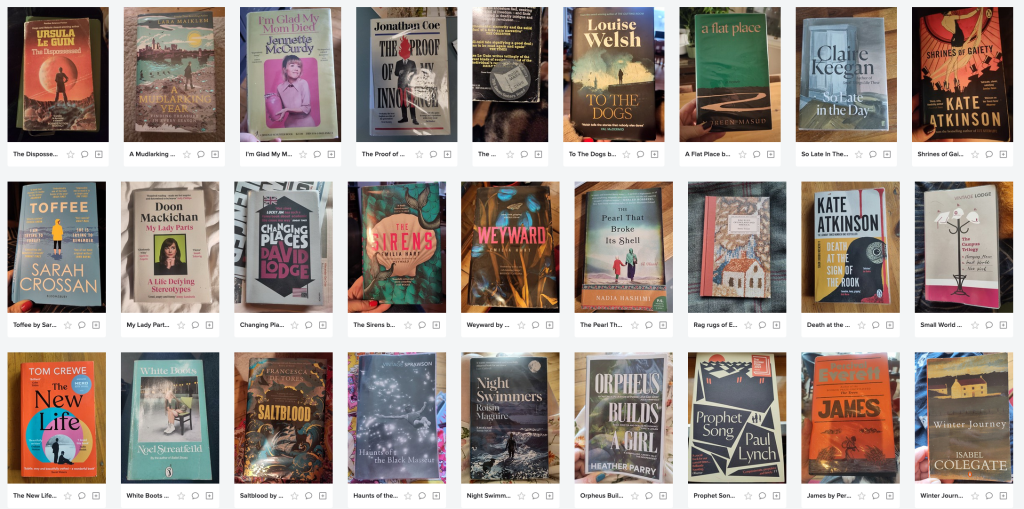
This was a bumper year for reading for pleasure: 56 books in total. And there are a few on the to-be-read pile that I’m half-way though but just didn’t quite find the right time to finish, so they’ll be the first readings for 2026.
Looking back on 2025, here are the books I selected and what I thought of them.
The Dispossed by Ursula Le Guin
My choice for Book Group. I’d read it many years ago, was keen to re-read – because Le Guin is writer of exceptional power, creativity and humanity – and to see what others thought. The journey of Shevek, a physicist, from a small, poor, anarchist society to a large, rich, capitalistic neighbouring planet in search of academic freedom, and the impact of this shock to both cultures, is rich, fascinating and deeply revealing of human aspirations and choices. Superb!
(Note: My copy of this book was sold in the 1970s by the BookMarx Club, top-notch punning from the lefties!).
A Mudlarking Year by Lara Maiklem
Lara Maiklem’s topic is the joy of finding random wee artefacts of the past, preserved and released by the great River Thames. I’m very up for that but perhaps I should have started with her first book. There were lots of fascinating finds and even the ‘duds’ hold interest. But the month-by-month structure made the chapters samey, and I felt a bit intrusive when reading her reflections about the impact of her mudlarking life on her partner and children.
I’m Glad My Mom Died by Jennette McCurdy
Eye-popping story of a child TV star who was dragged reluctantly out of normal childhood and into the glare of showbiz in an abusive attempt by her mother to fulfil her own dreams of glamour and stardom. That the story is told without self-pity and with plenty of good jokes only adds to the general, and compelling, atmosphere of perky horror.
The Proof of My Innocence by Jonathan Coe
Super-fun, very cleverly constructed detective story centering on the death of a political blogger at a right-wing conference in a country hotel. Presented in several parts in different styles, including one poking fun at the current explosion in cosy crime, this is a very well-written and satisfying read.
To the Dogs by Louise Welsh
As a former student (twice!) and one-time employee of Glasgow University this crime novel held particular attractions for me. From a poor childhood, Professor Jim Brennan’s on the verge of the biggest job at the Uni, when his son gets into trouble with the law. As as result he’s drawn back into the orbit of the Glasgow hard men. This was a really good read with some tricky moral complexities – does he make the right decisions to resolve his multifying problems? – with a great ending.
A Flat Place by Noreed Masud
This is an extrordinary memoir. Masud describes her attraction to flat places such as as Norfolk and Orkney, and that featureless ‘flat place’, the COVID pandemic. Gradually she reveals the strange, tension-laden, traumatic childhood that has given her a sense of comfort in these un-interrupted landscapes. The book – deceptively slim – is a portrayal of her specific circumstances and offers reflection on the impact of constraint and restriction and ways of reaching for recovery and freedom.
So Late in the Day by Claire Keegan
Another slim volume with so much to say, ever so quietly and subtly. It’s the story of a relationship gone awry, and as we see it through the thoughts of Cathal, we realise that Sabine has left him. As he recalls moments of their relationship, and also of his family life, it becomes tighteningly clear to the reader, though not to Cathal, why it failed.
Shrines of Gaiety by Kate Atkinson
Well, this is a lot of fun! The adventures of a young woman, a librarian from Yorkshire, who goes to London in search of two missing teenagers who are seeking a life on the stage. In the process she gets sucked into a world of nightclubs, crime, drugs and police, the racketty, seedy underbelly of the capital at play. The plot rattles along with gusto but the characters feel real and human too so you are concerned for their fates and hope for happy ending.
Toffee by Sarah Crossan
A Book Group Choice., This is a wonderful young adult novel, wittten in very short verse chapters. Allison has run away from her abusive father so when, Marla, an old lady with dementia mistakes her for her childhood friend Toffee, she goes along with it for shelter, food and safety. But inside this deception she starts to unfurl and learn more about who she really is and her emotional wants and needs. It’s very moving.
My Lady Parts by Doon Mackichan
A memoir by the actor and comedian about being a woman in the world of stage, screen, and stand-up. The rank sexism of the business is hard to read about sometimes, and there are also heart-breaking sections when she’s struggling to make ends meet, get work, care for her children including a critically ill child, and sustain a relationship. But she also keep pushing the boundaries with stage and TV shows and trying new things, including a stint in a team swimming the English Channel, which came as a surprise. Eye-opening and funny.
The British Museum is Falling Down* and Changing Places by David Lodge
David Lodge died on 1 January 2025 which made me realise I’d never read him. So I started with The British Library Is Falling Down – the comic experiences of a poor PhD student and his wife to manage their finances and their expanding family under the strictures of the Catholic Church in the 1960s. It made me laugh a lot so I then tried Changing Places, which I found equally as satisfying. This is the story of of two male academics – one from a fictionalised Birmingham and one from California, who swop jobs, and lives, for a term. As well as the comedy of manners of their intertwined situations, the overall depiction of university life in the the late 1960s/1970s, though no doubt inflated slightly for comic effect, was also a lot of fun. And I enjoyed feeling that it was expertly done – every piece of the shifting puzzle ends up where it should be.
*No photo.
Weyward by Emilia Hart
Tightly-plotted story of three women from different centuries living in the same isolated cottage in the north of England. Kate has fled from an abuse relationship, but while taking refuge in the cottage discovers that her ancestors, Violet in 1942 and Altha in 1619, also had to struggle against violence, constraints, and terror. But the cottage also connects her to her ancestors’ witchy magic and draws her into the resilience and beauty of the natural world. A riveting, spooky entertaining read.
The Sirens by Emilia Hart
Having enjoyed Weyward I went straight onto Hart’s second novel. This weaves together two stories of two sisters, contemporary and in the 19th century, and their relationships with each other but also with the ocean off Australia. One of the 21st century women flees to her sister’s coastal house only to find that she is missing. As she tries to find her she is disturbed by wild fantastical dreams of a baby, swimming and the sea. The mystery and the two linked stories made it gripping but I found some of the dreamy bits were too mystical for me, and as it was very similar in theme, despite the different setting, to her first one, I think I might have enjoyed it more if I’d waited a while.
The Pearl That Broke Its Shell by Nadia Hashimi
A Book Group choice. Set in Afghanistan in 2007, it follows the – frequently awful – experiences of Rahima, living with with her mother, sisters and a drug-addicted father. Because there is no capable male to run errands, negotiate with shopkeepers, and accompany the girls when they go outside, Rahima is ‘transformed’ by a quasi-legal custom into a boy. Meaning that she can wear boys’ clothes and enjoy boys’ freedoms. She later reverts back to officially being a girl but during the terrible sitation she’s then forced into, she is sustained by the story of her ancestor Shekiba who also found a way out of the gender norms of traditional Afghan society. The contrast between the folk custom and the clunky Western attempts to change the status and power of women was really interesting but there were flaws in the writing and characterisation which made it less compelling than it might have been.
Rag Rugs of England and America by Emma Tennant
A charming little book, with plenty of illustrations, looking at the craft and artistry of the makers of the rag rugs, created by women out of scraps of old material. It explains different techniques and identifies varying designs. As well as patterns and and common themes such as flowers, some are very lovely depictions of homes, animals and people, which I found very touching.
Death at the Sign of the Rook by Kate Atkinson
A Book Group choice. One of the Jackson Brodie mysteries, none of which I’d read before. But it was easy to pick up who was who and what was happening. A twist on a classic country house murder mystery, and a host of mildly comic characters, I found it all very funny with an accompanying warmth.
Small World and Nice Work by David Lodge
Having enjoyed Changing Places I returned to Lodge’s campus trilogy, which revisits some of the same characters and places new ones into the absurdities of academic life. In Small World, a PhD student in search of his romantic obssesion and various other professors and academic hangers-on, such as publishers and prize-givers, hurtle round the planet from conference to conference in a giddy, unstoppable merry-go-round reminiscent of a Buñuel film. It was funny but also a bit exahusting. But my favourite of the three was Nice Work, in which feminist literature professor Robyn Penrose is sent on a university-industry exchange with Vic Wilcox, manager of an engineering firm. It pokes fun at both their prejudices and satirises public policy on industry and higher education in the form of a classic 19th century ‘industrial’ novel. Very clever, very delightful and also very insightful.
The New Life by Tom Crewe
This was recommended to me because of its scenes of swimming in Victorian London, which in this scenario are closely linked to the repressed sexual desires of one of the male protagonists. The novel is a subtle and caring (and sometimes saucy) fictionalisation of a project of pioneering research work by two real men – John Addington Symonds and Henry Havelock Ellis – into human sexuality. In the course of the work, their own personal – on the surface, conventional – relationships are challenged and changed – sometimes beyond repair- while new ones arise. It’s really beautifully done and I loved it.
White Boots by Noel Streatfield
I was off to see Torvill and Dean, so what better way to prepare than to re-visit this favourite from my childhood? Poor sickly Harriet is told to try ice-skating to build up her strength. At the ice rink she meets rich, spoiled child champion Laila and the two become good friends. But as their friendship grows so does the pressure, on both of them. Thankfully there are enough good heads and good hearts around to help them come through. It’s a lovely story, charmingly told.
Saltblood by Francesca de Torres
I struggled a bit at first with this imagining of the life of Mary Read, a 18th century female pirate, on the high seas of the Caribbean. I think I expected a romp but the book is far more than that. It’s a dive into identity and how women survive in men’s worlds, sometimes as women and sometimes disguised as men, and how to negotiate the loss and peril as well as opportunity and pleasure when your public identity hides much of who you are. The writing is unusual too, lyrical and fluid. Though I found it a bit challenging at the time in the end I liked it.
The Haunts of the Black Masseur by Charles Sprawson
This book explores the history of swimmers, through great heroics, solitary swims, literary and artistic depictions and the author’s own attempt to swim the Hellespont. It’s an intellectually dazzling and thoroughly entertaining work incorporating history, art, literature and natural history, as well as diving into psychology and memoir as Sprawson tries to understand and share why swimming is so compulsive for some individuals.
Night Swimmers by Roisin Maguire
Yet more swimming, but oh dear, I did not like this at all. The main character is Grace, cold water swimmer, quilter and book reader. She’s supposed to be damaged and curmudgeonly but courageous and kindly. However I just thought she was mean and judgemental. Five minutes in and I wanted to join the gaggle of giggly, shallow, fair-weather sea-swimming girls who are the subjects of Grace’s disdain. Later, a family’s unhappiness is explained away with a very cynical option; using one most traumatic experiences any person could have as a handy plot device. But then, quirky village folk, home baking, rescuing seabirds, and ‘curmudgeonly but kindly’ Grace provide the healing. Yuk!
Orpheus Builds A Girl by Heather Parry
Super-gruesome story of an obsession that leads to a creepily horrible modern Frankenstein’s monster scenario. Overpowering mothers, dead girls, Nazi doctors all feature. But I was disappointed that it really spent far too long on the set-up and minutely imagining the physical and technical details of the revolting circumstances and very little time on the familial and societal reactions – some very unpleasant – when the truth comes out.
Prophet Song by Paul Lynch
A Book Group choice. The chronicle of a family in Ireland as the state is taken over by a militaristic, fascistic regime that cancels democracy and disappears its adversaries. Some of this was very good, such as the emotions of a family, and their friends and neighbours, as the wife of a missing man struggles to maintain normality, keep her family safe, and try to find her husband. But I was less convinced by some of the details as the repression grows, in particular, very early on when the husband, a high-ranking trade union official, goes to a meeting with the internal security services on his own. First thing you learn in ‘union school’ is always have someone with you in a meeting…!
James by Percival Everett
An amazing book. It reconfigures The Adventures of Huckleberry Finn from the point of view of the fugitive slave Jim, and weaving in the idea that, to stay safe from punishment, the slaves use an childish patois in public to reinforce the idea of their stupidity and ignorance to the white people. Amongst themselves, they converse in standard English, while Jim has taught himself to read and argues in his head with Voltaire about the inequity of slavery. As they navigate through many dangerous, vivid and heart-rending situations along the Mississipi River, when the story ends it’s clear that there’s a war coming and they – we – all have to pick our side.
(Note: Later in the year this was a Book Group choice, so I read it twice).
Winter Journey by Isabel Colegate
I’d enjoyed another of Colegate’s books (The Shooting Party) so picked this up second-hand. This was in a similar vein, being the story of tricky familial relationship but set in the 1980s rather than the 1910s. A brother – given to solitude and reverie – and a sister – used to being in charge and busy with plans – have a few weeks together on the family farm in the English countryside and gradually come to better understanding of each other and what the future might hold. It’s not a big story but both characters and the supporting ones felt real and lifelike and well worth spending time with.
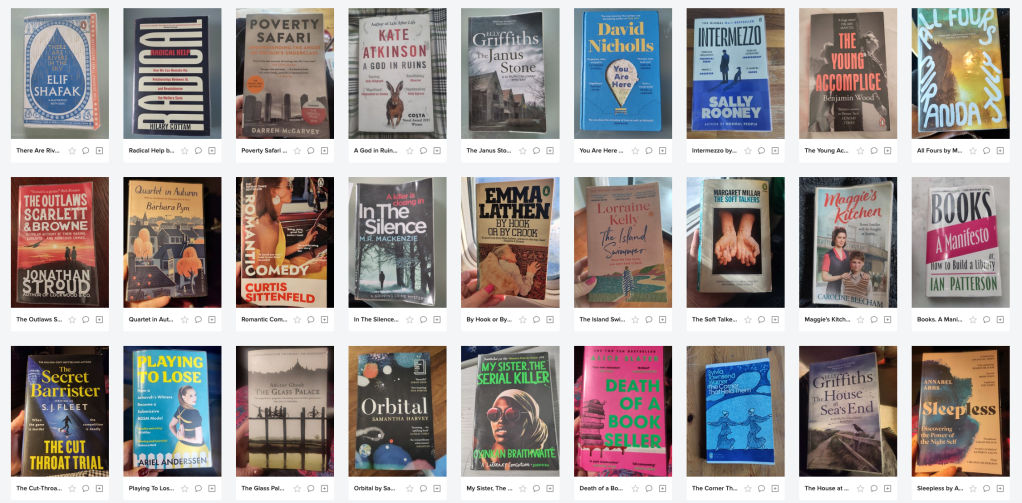
There are Rivers In the Sky by Elif Shafak
Running though this novel is the idea that water holds memory, and as a single drop of water travels through three stories ranging from palace intrigue in ancient Mesopotamia, to a poor but clever boy in Victorian London, and a girl growing up in a 21st century Yazidi community in Iraq, this reveals the links between these seemingly very disconnected lives. The mighty rivers, the Tigris and the Thames, are also key characters. It’s very ambitious and the writing is gorgeous in parts, but in the end I felt some of the human characters were being manipulated into the shape of the water story, which made it less compelling.
Radical Help by Hilary Cottam
Subtitled How We Can Remake the Relationships Between US and Revolutionise the Welfare State it’s obviously a book with some ambition! Firstly for such a weighty topic it was very readable, though after a while the style of introducing us to some individuals, stating a problem, and then saying ‘ but… what we thought about it this way?’ started to grate a bit. However its power is that it gives the layperson examples of real projects that demonstrate how taking different approaches to seeingly insoluble social issues makes a difference. Principally the idea is to move from patching up people and things to asking what does a person or family or community already have, how do they want to be living, and how can ‘officialdom’ remove obstacles – inluding its own interventions – to open pathways to this personal and community agency. It was very impressive and convincing, and also hopeful. I recommend to anyone interested in public policy.
Poverty Safari by Darren McGarvey
I chose this as a companion piece to Radical Help and there are some parallels in that this personal exploration of experiences of growing up in poverty, violence, and drug and alcohol abuse has a strong focus on personal agency. I hadn’t read it before partly because I felt that when it became a big hit McGarvey became the ‘pet’ of the ‘concerned middle class’ who would invite him ‘tell his story’ to public policy conferences before blithely getting on with business as usual. Turns out that McGarvey addresses this in the book, explaining that he decided to use his personal story as a ‘Trojan horse’ to draw attention to his idea that personal responsibility, supported by personal reflection and therapy, has to be central to change in people’s lives. While I’m all for that, the big flaw in his piece is that (as highlighted in the Cottam book) people are trying to operate within systems – in work, in education, and in welfare and health – that remove personal agency in favour of making people jump though the hoops of rigid parameters designed to spit out numerical outputs, not happy human beings. All individuals can do is take responsibility for how we manage that lack of agency, and that’s very much easier when you have money and options than when you don’t.
God in Ruins by Kate Atkinson
This is a life story, the life being that of Teddy, a RAF pilot in the Second World War, loving husband, caring but unsuccessful father, and devoted grandfather. It’s a beautiful and subtle account of the impact of loss, trauma and the disruption of war on, not just those who experience these, but down through the generations. It’s also a big sprawling, often funny, family drama with sly twists and turns reflecting on how we fictionlise our own lives and tell ourselves a tale about who we are, without perhaps ever realising the true impacts – big and small, good and bad – we make on other people. A truly excellent, absorbing read.
Corssing Places* and The Janus Stone by Elly Griffiths
A mystery set in North Norfolk with a forensic archaeologist called in to help local police – what’s not to like?! Crossing Places is the first in the Dr Ruth Galloway series, and in which she is asked to help Detective Harry Nelson identify the body of a child found in an desolate marsh who may be the victim of a letter-writer who taunts the police with seeming knowledge of a missing child a decade earlier. There are several potential solutions, plenty of twists and turns, and some personal danger for Ruth. Though I thought the characterisation was a bit clunky, I really enjoyed it, so went straight on to the second book. In The Janus Stone Ruth is needed for the discovery of a headless skeleton of a child under the doorway of an old house. Again there is some personal peril as she and the police distentangle the threads of the crime, and Ruth’s story also moves forward with new emotional developments in her life. All very readable.
*No photo
You Are Here by David Nicholls
Expertly-written, easy-to-read, and moderately amusing story of middle-aged romance set on a long distance hike though the Lake District. I like walking so I was sucked in by that setting however, while I thought this was quite nice, but it was perplexing to me that the single female – Marnie – was initially drawn to trying to connect with a really tedious man – rather than the obviously nice and funny chap. But otherwise, no novel, I guess!
Intermezzo by Sally Rooney
Some very different romances here, and much more complex and satisfying. The story of two brothers, one a charming and successful lawyer, the other a nerdy professional chess player, it explores their seemingly unconventional romantic lives and the tensions of their own sibling relationship following the death of their father. I found the relationships exhilaratingly convincing, the conversations were like eavesdropping, and while nothing earth-shattering really happens there’s a lot of tension. Fabulous stuff!
The Young Accomplice by Benajamin Wood
I really enjoyed this! Through a (mildly unlikely) small deception a brother and sister in a 1950s borstal are given the chance to become architecture apprentices with an idealistic young couple setting up a new life and professional practice in the Surrey countryside. But the sister – Joyce – struggles to fit in, and when a horrible man from her past – the cause of her incarceration – finds her, she’s sucked back into her old life, with devastating consequences. I thought it was so interesting; I loved the depictions of 1950s lives – the stifling conventions and the hopeful idealism – and found it both clever and gripping.
All Fours by Miranda July
A bestseller which to me felt quite like a TV show rather than a novel, perhaps because the protagonist is multi-media creator – a writer, musician, content creator – who scored some big hits in her youth but is struggling to nail her latest project, an interview with a pop star. So due to her edgy emotional state, instead of going on a business / fun trip to New York, she holes up in a cheap motel, spends $20,000 dollars on getting the room redesigned, and has an intense connection with a younger man. I enjoyed the pure zaniness and raced through it but also found it all a bit remote; her actions are so over-the-top and her life is so different from people with regular jobs, it did seem indulgent and fantasical. I also, weirdly, felt a bit short-changed that this crisis was precipitated by menopause, as if the only time women can ‘act crazy’ is when they have the ‘excuse’ of messy hormones. Very worth reading but just not quite my style.
The Outlaws Scarlett & Browne by Jonathan Stroud
A young adult fantasy novel I picked up randomly in the library. Set in a future England, fragmented and flooded, with tiny statelets vying against each other, and deadly monsters in the forest and rivers, Scarlett McCain moves from town to town, robbing and killing (when necessary) but trying to avoid swearing. She falls in with seemingly naive and polite Albert Browne who, it turns out, is on the run from some very nasty people. Great adventure story and very fun!
Quartet in Autumn by Barbara Pym
What a novel! Letty, Marcia, Edwin and Norman, are approaching retirement from unspecified unimportant jobs in a boring office. They each have a routines and habits – in some cases obsessions – that shape their lives. Aging and loneliness and obsolence are ever-present themes in the book, although, despite their distance from each other, three of them do try to rally round when one is in real trouble. Every sentence has meaning, insight, and wit. And though they are constrained by circumstances they still have and value their independence, even if its just the thoughts in their heads. It’s exquisite: funny, moving and true.
Romantic Comedy by Curtis Sittenfeld
This felt like at least two different novels, neither of which, sadly, were very good. The first is in the offices of an American daily comedy show where writer Sally is disgruntled to find that the latest celebrity presenter, pop star Noah, wants to include his own material in the show. Turns out his idea is ok and in working together Sally and Noah do a bit of flirting… The nascent romance is, as required, thown off course, only to be picked up again during COVID lockdown – the ‘second book’ – when Sally and Noah get closer via – what I considered to be – very tedious emails. Part one is good on the frenetic pace of the TV production. Part two is flat as a pancake. I found Noah very dull, Sally annoying, and the jokes lamentable, so it didn’t work for me, which is shame because I think many of her other books are much better,
In The Silence by M.R. Mackenzie
I read this mostly because it was set in Glasgow, specifically the west end , which is where I live, so bonus! Apart from that, it was ok…. An emotionally distant protagonist returns to Glasgow for the first time in ten years only to get embroiled in investigating a murder involving people she knew as a student. There was a bit of a theme about how the law disadvantages women which was of mild interest but the characters and writing didn’t really enagage me. Though there’s now a series so obviously plenty of people disagree!
By Hook Or By Crook by Emma Lathen
When a long-lost matriarch in family firm of Oriental rug importers is found in the Middle East the heirs to the business are simultaneously surprised and suspicious. When she’s murdered just hours after arriving in New York they are in turmoil. I enjoyed the 1970s business setting and the fact that the investigator was an insurance agent. Easy, fun read with a classic murder mystery twisty vibe.
(Note: Emma Lathen was actually two US businesswomen who wrote the books together).
The Island Swimmer by Lorraine Kelly
I don’t want to diss lovely Lorraine but this is truly terrible. I was sucked in by the swimming angle but there’s really no swimming in it, and the story – something to do with sisters and a ‘terrible’ secret – is boring and unbelievable. Oh dear.
The Soft Talkers by Margaret Millar
A superb psychological 1950s murder mystery. Following the mysterious death of a Canadian businessman on the eve of a fishing trip with pals, the story is constructed from the points of view of other members of his circle of friends and their wives, all with their resentments, entanglements, and secrets. Quite some later, one of them works out what has happened and who’s responsible. It’s clever but rings true, being seedy and dark, with top-notch, razor-sharp writing.
Maggie’s Kitchen by Caroline Beecham
I was drawn to this because of the theme of British Restaurants, which were Government-supported canteens serving cheap, nutritious food during the Second World War when people were often on the move or lacked a kitchen or time of their own to cook. Maggie loves cooking and this chronicles her struggles to open the restaurent whilst helping a homeless orphan boy and developing a relationship with a Polish refugee. I liked the details about the canteen regulations and the food she cooks, but found the personal stories a bit uninvolving.
Books. A Manifesto by Ian Patterson
Picked this up in the library on whim, thinking, a little book about books, how nice. And was surprised. He uses the framework of retiring and moving house and thus getting rid of some books and re-organising other books – literally building his new library – to reflect on different aspects of his bookish life. It moves from radical reading, revolutionary socialism and translation, to running a bookshop, and becoming an academic and teacher. It is about books – from classics and post modernism to murder myseries and school stories – but really its more about how the books we read build us. And it has a fulsome appreciation of Jilly Cooper which, strangely, I read just a few days before she died.
The Cut Throat Trial by The Secret Barrister, writing as S.J. Fleet
Oh this was great!. It’s the story of a murder trial, built up from many different perspectives – prosecutor, judge, defence lawyer, and the three accused – which opens up the processes of the legal system, and the skills, the incapabilties, the the emotions, the prejudices, and the calculations that go into every small decision made in a major court case. It is very cleverly constructed and really draws you into how justice is a hit and miss business, where truth can take second place to other, hidden pressures. An excellent read!
Playing to Lose by Ariel Anderssen
So much of this year’s reading was random library books, this being one of them. A memoir by a woman who grew up in a strict religious home who became a model for bondage and sado-machism websites. It’s quite well written, and she make connections between her early life and the choices that led her to her now – happy – place via some less happy situations. Obviously it’s also an insight into an unfamiliar world, which was eye-opening, though she’s careful to frame it in terms of consent, highlighting the capacity for abusive situations. A moderately interesting read.
The Glass Palace by Amitav Ghosh
I really enjoyed Ghosh’s Sea of Poppies trilogy about the opium trade. This is a similar work, a family saga set across Burma, India and Malaya, but it’s less polished. The book follows the fortunes of a young boy called Rajkumar, who briefly meets a girl in service with the Burmese queen (later deposed by the British) and who goes on to build a teak and rubber business empire, marry the girl and found a dynasty. It’s quite a complex book, as then it goes on to describe the events in the lives of their children and grandchildren. I enjoyed the historical details – for example, I didn’t know about the Indian nationalists who allied with the Axis Powers in the Second World War to hit back at the British Empire – but with so many characters I got quite confused about who was who, and who was where, and it became a bit of a slog.
Orbital by Samantha Harvey
A Book Group choice. Six astronauts circle the Earth 16 times in 24 hours and we experience this time through their routine tasks and individual thoughts about their motivations for going into space, the sacrifices they are making and how they are reacting to living in a tiny space above the planet disconnected from people they know. As well as the awesome sweep of space and the wonder the Earth inspires, there are little human details that help to keep us focused on people as well as the planet. It’s a good book though not a simple read. Slim but weighty.
My Sister, The Serial Killer by Oyinkan Braithwaite
Poor Korede receives the call she dreads; her sister Ayoola needs her help to get rid of a body, this chap being the third man that she has dispatched, allegedly in self-defence. This darkly comic novel, located in Nigeria, portrays Korede’s impulse to protect her sister – including ‘clearing up’ after her – and the sacrifices that she makes for her family, including nixing a romance to try and save a man she likes from the same fate. It’s outrageous, sharp and funny but also bleak. Korede knows her sister is a monster, and that her own complicity is deepening, creating an uncertain future.
Death of Bookseller by Alice Slater
Another black comedy, this time centred on the true crime ‘industry’. Repellent Roach works in a declining bookshop and is obsessed with true crime books and podcasts. When cutesy new manager Laura arrives, a miscommunication makes Roach think she’s found a fellow murder fan but when Laura, for very personal reasons, refuses to be drawn in, Roach become obsessed with her as well. She starts to stalk and gaslight Laura who is already in a fragile state. I really enjoyed this; it presents a slightly heightened reality, perhaps reflecting the world views of two unreliable narrators who are both disconnected from the quotidient in different ways. Creepy, unsettling, and satisfying.
The Corner That Held Them by Sylvia Warner Townsend
My choice for Book Group. I found this delightful, if somewhat confusing at first. It tells the story of a community of nuns, from foundation in memory of an unhappy wife, through a procession of superfically interchangeable abbesses and other office-holders. Through the comic characters and interactions of the nuns, their priest and the villagers, the social and economic life of the community is revealed, including explosions of violence as frustrations erupt. Funny, insightful and surprisingly modern.
The House at Sea’s End by Elly Griffiths
The third in the Dr Ruth Galloway series, and this time coastal erosion exposes six bodies for innvestigation by her and Detective Harry Nelson. With no need for Griffiths to divert from an successful formula, as she works on the case Ruth also has to make choices about her job and her private life, and revisits her past, specifically her time as a young archaeologist identifying bodies in mass graves in Bosnia. Again, a good satisfying read and I’ll certainly be going on to read more.
Sleepless by Annabel Abbs
Following two bereavements Annabel Abbs experienced prolonged and insistent insomnia. However, after some ineffectual struggles to defeat it, she decided to accept the sleeplessness and explore insomnia, night-time and darkness, in particular their significance for women. I don’t have insomnia but I love the night and darkness, so much of what she found rang very true to me: particularly that at night – and there is scientific data to back this up – people become less inhibited, feel greater creativity, and are more at one with their wild sides. For women, traditionally constrained and taught to be scared of the dark, this sense of freedom from scrutiny is especially preccious. Through watching the night sky, walking in the dark, sleeping under the stars, and other practices, Abbs found ways to embrace her ‘night self’. This was a fascinating read, and a good book to read in depths of dark midwinter.
 Lucy Janes
Fabulous – and some recommendations to go on my TBR.
LikeLike